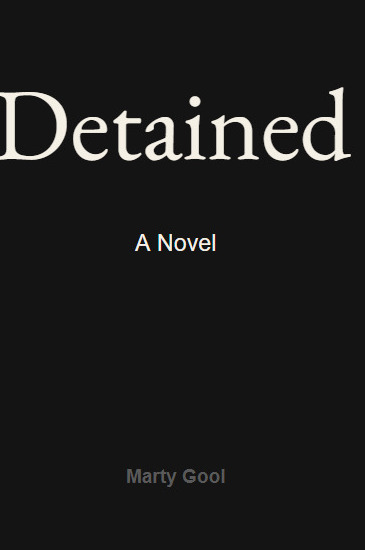
Why Detained Is Here
The following excerpt comes from the coda of my book Detained, titled "The Gate." I include it here because it speaks directly to the question behind this site: Is God punishing me? In this story, the suffering people endure is not God's punishment. It is human punishment — organized, legalized, systematized, and then made to sound holy through religious language. The danger is not faith itself. The danger is what happens when Scripture is read through fear, nationalism, control, and punishment instead of through the character of God revealed in mercy, justice, and restorative love.
Excerpt from Detained — Coda: "The Gate"
Crane woke before sunrise.
He always woke before sunrise. Thirty-one years of it. His wife said he was like a rooster — not a complaint, a fact, the way you state the facts of a person you have lived beside long enough that their facts have become the weather.
He did not wake her.
He put on his robe. He went to the kitchen. He made coffee the way he had made it for thirty-one years — four scoops, the good filters, the water measured. Not approximate. Approximate coffee was suggestion and he did not have time for suggestion. He had work to do and the work required clarity.
He took the cup to his study.
He sat at his desk.
His father's desk. Oak. Scarred along the left edge where his father had set a soldering iron down without thinking when Crane was seven years old. The scar had been there ever since — through his father's life and his father's death and the moving of the desk from house to house to this one, the last one, the one he intended to die in. The one his grandchildren knew as the house with the study that smelled like coffee and old paper and serious things thought for a long time.
He opened his Bible.
He opened his journal.
He uncapped his pen.
He wrote the date. Then he began.
He wrote: Lord.
Just that first. The word his father had taught him. The word he had taught his children. The word his grandchildren were learning now the way children learn the things that matter — by hearing them said by people they trusted in the tone that meant this is real, this is the realest thing, this is the thing underneath all the other things.
He wrote: Thank you for the work. Thank you for the platform. Thank you for the men and women doing the hard things that hard times require. Guard them. Give them wisdom. Give them the spine to do what is right when what is right is not what is easy.
He stopped.
He looked out the window.
The sky was beginning. Not light yet — the darkness going from black to the deep blue that comes before color. The moment the night admits it is ending without yet admitting what will replace it.
He wrote: Protect this nation. You know what we are. You know what we have been. You know what we could be if we are faithful. I am asking for faithfulness. I am asking for the courage to close the gate and call it love. I am asking for a church that will not go silent. I am asking for leaders who will not flinch.
He stopped.
He looked at the scar on the left edge of the desk.
His father had been a quiet man. Who said little and meant everything he said. Who built things with his hands — the desk, a bookshelf still in the house, a birdhouse in the backyard that had weathered thirty winters and still held. Who loved his family practically, daily, in the specific acts of a person who shows up for the thing in front of him.
His father had never stood before twelve thousand people.
His father had never testified before Congress.
Every night of Crane's childhood his father had walked out to the small farm on the edge of town and closed the gate and walked back. That was the act. Love made practical and nightly and unspectacular.
Crane believed he was doing the same thing.
At greater scale.
With greater consequence.
But the same thing.
He wrote: I believe the work is righteous. I believe the order is yours. I believe the boundaries you set are the boundaries we are keeping.
He underlined it.
He wrote: Amen.
He capped the pen.
He closed the journal.
He looked out the window.
The sky was going orange at the edge. The orange that comes before the sun — the promise of the thing and not the thing itself. He held his coffee cup in both hands and watched it and felt the thing he always felt at this moment.
That the world was ordered.
That the order was good.
That the order was God's and the work was God's and he was inside the will of God and the doing of it was righteous and the righteous thing was the loving thing and the loving thing was the closing of the gate.
Completely.
Without remainder.
He did not think about Luisa Méndez.
He did not know Luisa Méndez existed.
He did not think about Tomás — seven years old, his father's jaw, his father's way of sleeping with one arm thrown over his head as if reaching for something — in a facility somewhere in south Texas with the white lights that did not vary and a number card in his pocket and three words he had heard his mother say so many times they had become the only prayer he knew.
Forward. Just forward. One foot.
He did not think about Abdullahi Osman sitting correctly on a bench with his eyes on a wall that had nothing on it. He did not think about Khalid standing in a hallway in Minneapolis in his socks with a passport in a drawer ten feet away that the order had already decided was not a variable. He did not think about the girl in room 6C with her knees to her chest watching a door that did not open. He did not think about Myra sitting at a kitchen table with a pen on a blank page beginning a sentence the system had no form for.
He did not think about any of them.
This was not cruelty.
This was the structure of the machine. The Dragon's oldest and most perfect work — not the cage, not the form, not the response window of 72 hours. Those were symptoms. The disease was this. A man at a desk at sunrise with coffee made correctly and a father's scar on the oak and a genuine love for his grandchildren and a theology that was complete — that had an answer for everything, that had taken the Dragon's oldest lie and run it through thirty-one years of Scripture and prayer and morning journals and come out the other side as gospel.
The cure was the disease.
The disease was the Dragon.
The Dragon was in the room.
He prayed at sunrise.
The gate opened.
Three hundred and twelve miles south the bus turned off Highway 83 onto the access road. The driver did not slow for the turn. He had made it forty-two times.
The gate was already open.
It was always open at this hour.
The man in the blue vest was already there. Clipboard. Thirty-one numbers. Already counted. Already waiting.
The bus stopped.
The door opened.
The light came in.
They came down the steps the way they always came down the steps — one at a time, blinking in the light, carrying what they had carried across however many miles and days it had taken to arrive at this gate at this hour. A woman with a child on her left side. A man alone. Two teenagers together. An old woman who took the steps slowly and the man in the blue vest did not move to help her and she did not ask him to.
They came down the steps.
The man in the blue vest held out the cards.
The system received them.
Three hundred and twelve miles north Crane washed his coffee cup.
He dried it.
He put it back in the cabinet.
He went to wake his wife.
The sun was up.
The gate was open.
The bus idled.
The system worked exactly as designed.
And the Dragon — who had no pitchfork, who had no tail, who had no form that anyone would recognize as the Dragon, who lived in the theology and the journal and the pen uncapped at sunrise and the word amen written in the dark and meant — the Dragon was satisfied.
The flock was being processed.
The shepherd was at his desk.
The gate was open.
And the sun came up over a nation that had been told it was chosen.
And the sun came up.
And the gate was open.
And the system received them.
And the Dragon was satisfied.
And the sun came up.
Why This Matters
This is why Detained belongs on this site. The book is not saying God punishes the vulnerable. It is saying people can build systems that punish the vulnerable and then use God-language to protect those systems from repentance. The question is not only, "Is God punishing me?" Sometimes the deeper question is, "Who taught me to call this punishment God?"