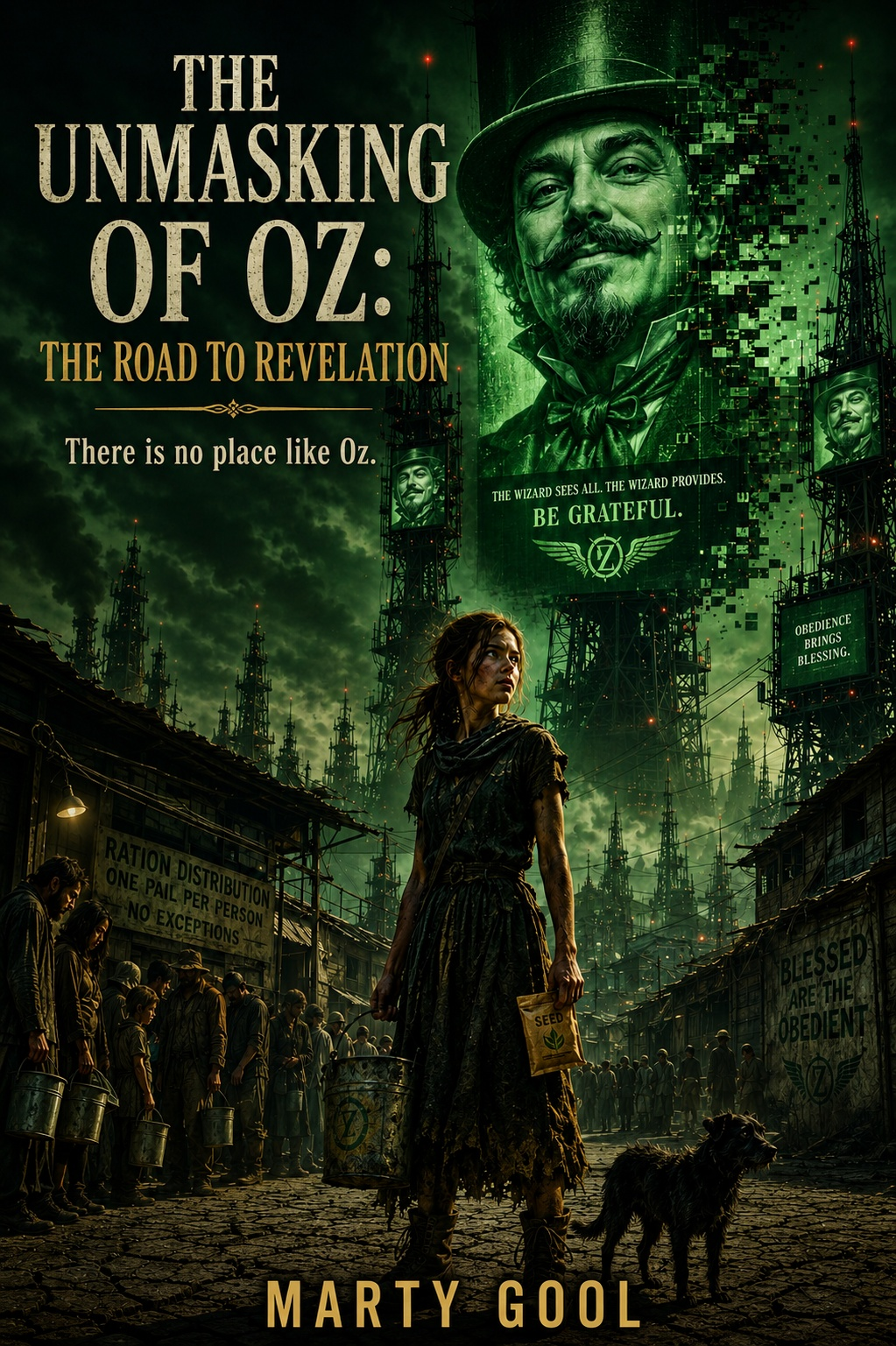
This excerpt begins when Dora reaches the Emerald City. By this point, she has learned that Oz does not only control roads, food, labor, and speech. Oz controls sight. At the gate, she discovers that entrance requires a lens — and that every empire first teaches people how to see.
Chapter 11: The City Requires a Lens
The road ended at a gate.
The gate was small.
A city the size of a horizon had a gate the size of a kitchen door, and Dora understood before she crossed it that small gates were not modesty. Small gates sorted.
A guard waited beside it in a green coat trimmed with gold. He carried no rifle. He carried a wooden box on a strap and a clipboard tucked under one arm. His mustache had been combed. His smile had been issued.
"Pilgrims," he said.
"Yes."
"From?"
"The Dust District."
He wrote without looking down.
He opened the box.
Inside lay green disks in velvet pockets, thin as a fingernail, polished, and when he lifted one between two fingers it caught the daylight and held it the way the screen at the platform had held Silas Brace's clean shirt before the cut to the seal.
"For your protection," he said.
He did not say from what.
In Oz, protection was always offered before the danger was named, because the offering created the danger in the mind of the one receiving it. A citizen who was protected had already agreed there was something to be protected from. The agreement came first. The threat could be supplied later.
Dora looked at the disk.
"What does it do?"
"It adjusts the light."
"The light?"
"The light of the city is very strong. Unprotected eyes have been known to weep."
He said weep as if weeping were the danger.
He did not say the city was the danger.
He did not have to.
"Do we have to wear them?"
"No. You may also remain outside the gate."
He smiled while he said it.
That was Oz too. The choice the city offered and the choice a person would have made were not the same choice, and the city was honest about which one it provided.
The Straw Man's torn sleeve stirred against his chest. The Tin Man's hand pressed the rusted seam where the false heart had bitten him. The Lion stood with dried blood beneath his mane. Toto pressed against Dora's ankle and made no sound.
The guard's pen moved across the clipboard.
The lens was already counting them.
Dora took it.
The Straw Man took his. The Tin Man took his. The Lion took his.
Toto was not offered one.
Animals, unregistered.
The category had its uses.
"For yourself first," the guard said.
Dora closed her left eye.
She placed the lens over her right.
The city arrived.
Fountains lifted at every corner, white arcs falling into stone basins carved with vines. Banners ran from every tower in green and gold, rippling in a wind assigned to them. Music came from nowhere, strings and bells and voices lifted in something built to make the body lean toward the sound. Citizens walked in green that shone faintly from being cared for. Children ran among them.
The children were laughing.
Not the careful laughter of the bypassed village. Not the laughter behind hands. Laughter that came up from the chest and out into the air without checking the ceiling first.
Dora's throat closed.
She had not seen children laugh like that since before she could remember, and her body recognized the laughter before her mind could decide what to do with it. Her shoulders softened. Her wrist stopped hurting where the ribbon had bitten her.
That was the first work of the lens.
It comforted before it was questioned.
It gave a body its rest before that body could ask what the rest had cost.
"You see," the guard said softly.
"I see."
"It is beautiful."
"Yes."
"It is true."
He said it the way the Wizard had said there is no place like Oz.
He said it as though saying made so.
Dora closed her right eye. The wall returned. The road returned. The sky returned. The city she had just seen was gone.
She opened her right. The city came back.
The guard's pen paused.
"Stop that," he said.
His voice had not raised. It had only emptied of pleasantness for a breath. Inside that breath Dora heard the thing the smile had been hiding.
"Stop what?"
"Comparing."
Comparing. That was the sin. Not refusal. Not insult. Not theft. Comparing. Oz had many rules, but its deepest rule was that the eye must not be permitted two pictures at once. One picture could be governed. Two could not. A citizen with two pictures became a citizen with a question, and a question, in Oz, was a seed.
Some seeds got people killed before harvest.
Dora lifted the lens away from her eye. She held it at arm's length, between herself and the wall, and looked around its edge.
There was a doorway in the wall she had not seen before.
Low. Plain. Cut into the wall at ground level a few paces from where the guard stood. A child sat beside it in a coat too thin for the wind, a coat that had been someone else's coat first and someone else's before that. The child was eating from a piece of paper. The paper had held something larger once, something the child had not received.
The child saw Dora seeing.
The child did not smile. The child did not wave.
The child only looked.
Dora knew that looking.
She had seen it on the eastern screen after Silas Brace died. She had seen it in the field of red flowers when the Lamb had stood where the sweetness could not reach him. The looking was the same looking. It belonged to those whose mouths had been edited. It belonged to those whom the broadcast had decided not to carry.
The guard cleared his throat.
Dora's hand jerked. The lens dropped back over her right eye. The fountains rose. The banners rippled. The children laughed.
The child by the wall was gone.
She lifted the lens away again. The door reappeared.
This time she saw the marks. Scratches. Names. Numbers. A long list cut into the wood by whatever the scratchers had had to scratch with. Pieces of metal. Buttons. Fingernails. The list was longer than the door, and it climbed sideways onto the stone where the wood ran out.
The Lion looked where she was looking.
He had been a preacher.
His breath stopped.
"What is it?" the Tin Man asked.
"A memorial," the Lion said.
"To what?"
"To the ones the city did not let in."
The names on the door were not the city's shame. The names on the door were the city's record. The city kept its accounting on the outside of the wall so the inside could remain what the lens said it was. That was how empire bookkept. It did not destroy the evidence. It moved the evidence to a surface no citizen had been trained to look at.
"The lens, please," the guard said.
Dora put it back over her right eye.
She turned to her companions.
"Put yours on."
The Straw Man's painted mouth tightened.
"Dora."
"I will tell you when to take them off."
"Even if we have forgotten the word?"
Her eyes filled.
"Especially then."
They placed the lenses. Each of them flinched as the city arrived.
The gate opened.
The avenue was wide. The pavement shone. A woman in green passed them carrying a basket of bread. She smiled at Dora and bowed slightly. A man in green stopped to lift a fallen child to her feet, brushing dust from her green coat, and the child laughed and ran on. A fountain rose at the corner, water arcing white into a basin that did not measure what it gave. No one stood in line. No one carried a tin pail.
Dora lifted the lens away from her right eye.
The fountain was a pump.
The pump was iron. The basin beneath it was cracked. The water that fell from it was rust-colored and slow. A woman knelt beside it with a green rag, painting the iron the color of fountain. Her hands moved quickly. Her knees were wet. A child sat against the basin behind her, holding a cup that had been empty for a long time.
Dora put the lens back.
The fountain rose white.
The painted woman was gone.
The cup was gone.
The lens did not hide the woman. The lens taught the eye that the woman was not what the eye had come to see. The eye saw fountain because the eye had been trained to assemble fountain from the materials in front of it, and the painted woman was not among the materials.
That was the difference between blindness and catechesis.
The blind could not see.
The catechized could see and call it something else.
A citizen passed.
She was older. Her green coat had been brushed that morning. She smiled at Dora with the smile that had been issued at the gate.
Dora lowered her lens.
"Excuse me."
The woman stopped.
"Yes, dear?"
"There is a woman painting the pump."
The woman tilted her head.
"What a thing to say."
"There. Beside the fountain. She has a rag."
The woman looked toward the fountain.
She looked back at Dora.
Her smile did not change. Her eyes did not move toward the kneeling woman. They crossed her and passed her and rested on the white arc of water.
"It is a lovely fountain. It has been there since I was a girl."
"Do you see the woman?"
"I see the fountain, dear."
"She is right there."
The woman reached out and patted Dora's cheek.
Her hand was warm. Her fingers smelled faintly of soap. Her palm rested for a moment against Dora's face the way Aunt Em's palm had rested against the back of Dora's hand in the kitchen after Silas Brace died.
"You have just arrived," she said. "The light is very strong here. Your lens has not yet settled. You will see properly soon."
She smiled and walked on, humming with the music.
Dora's chest tightened.
The woman was not lying.
That was the worst of it.
The woman had looked. Her eye had crossed the kneeling figure. Her eye had not refused. Her eye had seen, and what her eye had seen was fountain, because fountain was what her eye had been raised to make from the world in front of it.
She did not need to be deceived. She had been formed.
The lens at the gate was the small thing.
The lens at the gate was what the city handed a stranger so the stranger would not notice that everyone born inside had been wearing one since before they could speak.
The Wizard had not put the lens on the people.
The Wizard had put the lens on the world.
The people had grown up inside the world.
The Straw Man lowered his lens.
He looked at the avenue without it.
He looked for a long time.
He had been hung in a field for asking who taught the road where to turn. He had been cut down. He had walked a road that taught while pretending not to teach. He had refused a certificate that wanted to eat his hand. He had been told he had no brain because his thinking had been inconvenient, and he had survived that telling, and the surviving had been a kind of thinking the city had not anticipated.
He turned his painted face toward Dora.
"She is not pretending."
"No."
"She believed her own eye."
"Yes."
His torn sleeve stirred.
"Then she has been catechized."
That was the word.
That was what the Lion had been trying to name in the burned sanctuary, and what the Tin Man had been trying to name when he said he had only become useful to the thing that emptied him, and what Aunt Em had been trying not to say when she lowered her head in the morning line not all at once but gradually, the way a body learns a prayer it no longer remembers choosing.
Catechesis was the lens before the lens.
It was the teaching that made the seeing.
The Tin Man lowered his lens.
The Lion lowered his.
They stood in the middle of the bright avenue with four lenses in their fists, and the citizens passed around them, and not one citizen turned a head.
The Tin Man looked down.
The pavement was glass.
He had not noticed through the lens. The lens had shown him stone. But the stone was glass, and the glass was thick, and beneath the glass was a room.
People sat on benches that lined the walls. They wore no green. They wore what they had worn when they arrived, which had once been clothing and had become covering. They did not look up. The light from the avenue passed through the glass and fell on their faces in pale squares, and the squares moved when the citizens above moved, and the people below did not lift their faces into the moving light.
A child among them was sleeping.
The Tin Man made a sound.
Oil gathered beneath his eyes and ran in two lines past his jaw and dripped onto the bright pavement.
Where the oil fell, the glass cleared.
Beneath the cleared place, a woman lifted her face for the first time and saw the falling oil and did not understand what it was.
It was tears.
It was the grief the false heart had tried to cut out of him in the field of gifts with teeth. It was the grief that had cost him a strip of his chest plate when he had refused. It was the grief Oz had called inefficient at the mill and waste in the casket and now had called nothing at all, because Oz had built a city in which grief that arrived from above the glass could not be named by those below the glass.
The Tin Man knelt.
He pressed his metal hand flat against the glass.
The woman beneath lifted her hand and pressed it against the underside.
Their hands did not meet. The glass was between them. But the woman's hand stayed where his was, and his hand stayed where hers was, and a citizen passed and glanced down and smiled.
"The light is very strong, dear. Your lens has not yet settled. You will be able to walk soon."
She walked on.
The Tin Man did not lift his hand.
Dora knelt beside him.
She set her palm on the glass next to his. Below them, the woman shifted her hand so that it rested under both.
Three hands.
One thickness of glass.
That was the city.
The Lion knelt.
The Straw Man knelt.
Toto pressed his nose to the glass.
Below them, more faces lifted. A man. Another woman. A boy who could not have been older than the child by the wall. They did not call out. They had learned that calling out did not cross the glass. They only lifted their faces, and they kept them lifted.
The Tin Man's chest knocked beneath his torn plate.
It was the wound the false heart had refused to remove.
It beat once. It beat twice.
The wound was the witness.
A heart that had been emptied of pain would have walked over this glass. A heart that had been spared the memory of Mara would have seen the fountain and not the pump. A heart that had been talked out of its grief in the white field would have been the city's perfect organ.
The Tin Man had refused that heart.
The rust beneath his eyes had been the proof.
The proof was now falling onto the glass and clearing the place where a woman could lift her face into pale squares of light that moved without naming her.
Dora looked up.
Above the avenue, far down its length, a tower rose taller than the others. Green light pulsed at its crown. The Wizard's banner ran from its highest window to its lowest. Through the lens, the banner rippled like scripture.
She lifted her lens away.
The banner was the same banner. The cloth was the same cloth.
The wind that moved it was not wind.
A machine moved it. She could see the wires that ran from the machine to the cloth. She could see the platform built into the tower from which the cloth was tended. She could see the men in green who unfurled it each morning and rolled it each evening, the rotation of the lights that made the banner appear to ripple even when the air was still.
The banner was a banner.
The wind was a story.
Every glory in Oz had its machinery.
Every machinery had its tenders.
The Wizard's face in the Dust District had been a broadcast. The Wizard's voice in the kitchen speaker had been a circuit. The Wizard's banner above the Emerald City was cloth on cable in a room full of green men whose labor had been classified as worship.
The Lion lifted his head.
He had been looking at the upper windows of the tall houses across the avenue.
Through the unprotected eye, the windows held soldiers. Each window. Each upper floor. Rifles laid across knees. Faces turned toward the citizens who walked beneath them in pleasant green.
The soldiers were not hidden.
That was what undid him.
The lens did not hide the soldiers. The lens trained the citizen never to lift the eye to the upper window. The eye stayed at the level of the fountain. The eye stayed on the laughing children. The eye stayed on the smiling neighbor.
A city did not need to hide its rifles when it had taught its citizens not to look up.
The Lion's mouth moved.
The roar was not in it.
"In the sanctuary we knew," he said.
"Yes."
"We knew the wires ran into the pulpit. We knew the broadcast stand had been bolted where the rail had been. We knew Oz had entered the church. Some of us preached against it. Some of us went quiet. But we knew."
He looked at the woman who had patted Dora's cheek.
She was farther down the avenue now, still humming, still smiling.
"She does not know."
"No."
"She would not believe me if I told her."
"No."
His throat moved.
That was the deepest cruelty Oz had managed.
In the district, the people had known and feared. Fear was bondage, but fear was also memory. Fear meant the body still recognized what was happening to it. In the Emerald City, the people had been freed from fear by being freed from knowing. They walked their bright streets in genuine peace, and the peace was real, and the peace was the proof of the wound.
The wound was that they had been made glad of it.
The Straw Man rose first.
He looked down at the lens in his hand. He turned it once between stitched fingers.
He let it fall.
It struck the glass with a small clean sound and lay there, green on green, a coin in a fountain that was not a fountain.
The Tin Man rose. He opened his metal hand. The lens fell.
The Lion rose. The lens fell from his paw.
Dora stood last. She lifted her own.
She thought of Aunt Em counting water, which had given shape to lack. She thought of Uncle Henry looking at soil, which had told the truth without amplification.
She let it fall.
The four lenses lay on the pavement in a small green pile.
A citizen passed.
She did not look down at the lenses. She did not look at the four bodies standing without them. Her smile did not change. Her step did not slow.
Her eye crossed the place where they stood and assembled, from the materials it had been taught to use, an empty avenue.
She walked through them.
Dora felt the woman's sleeve brush her arm.
The woman did not feel it.
In Oz, the catechized did not register what they had not been taught to call something.
A body without a lens was not a body.
A body without a lens was a kind of weather, and weather did not interrupt a walk.
Toto growled.
He had not been given a lens. He had been smelling the city since they crossed the gate, and what he smelled had not changed since the gate, and he had no eye to be taught what to call it.
Dora bent and lifted him into her arms.
His body was warm against her chest.
She walked.
The companions walked with her.
They walked down the bright avenue with their lenses left behind on the glass, four bodies the citizens passed without seeing.
The banner rippled at the end of the avenue.
The machine that moved it hummed faintly beneath the music.
Somewhere above them, in an upper window, a soldier turned a rifle slightly to track them as they passed.
He had been trained to see what the citizens could not.
That was his catechesis.
Somewhere beneath them, the woman with the lifted face kept her hand on the glass.
Somewhere ahead of them, the Wizard waited inside the tower whose banner was tended by men.
The Emerald City sang.
The companions walked toward the song without wearing it.