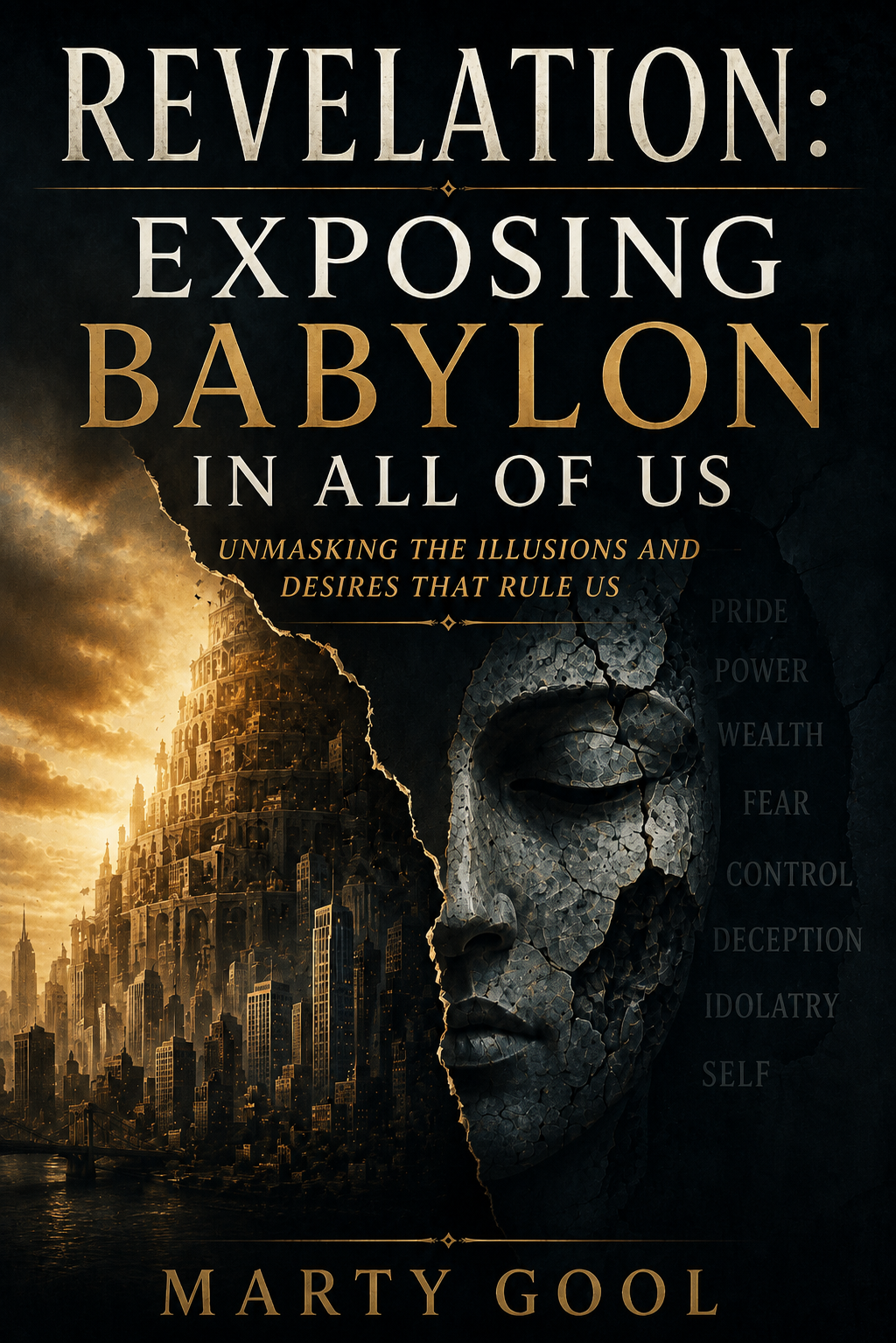
Unmasking the Illusions and Desires That Rule Us
Revelation: Exposing the Babylon in All of Us
Unmasking the Illusions and Desires That Rule Us
by Marty Gool
The unveiling begins on a rock in the sea, inside a man's loss.
Instant download: Includes PDF + EPUB for all devices.
Read an Excerpt
Revelation has often been approached as a book about what is coming.
This book asks you to begin somewhere else.
It asks you to look at what is being uncovered.
The images ahead are severe. There is fire. There is judgment. There are seals, trumpets, bowls, beasts, collapsing systems, and a city called Babylon. None of that will be softened.
But neither will those images be allowed to change the character of God.
The movement of this book will take place at two scales.
It will look at what fear builds inside a person.
It will also look at what fear builds when it acquires power, structure, law, market, and empire.
Those scales are not identical.
But they can share the same architecture.
And through both, one question will remain:
Has God changed?
The chapters ahead will answer that question by allowing Revelation to do what its name announces.
Unveil.
The first chapter begins there.
Chapter 1. Reclaiming Revelation
The book is named for a Greek word. Apokalypsis. We hear it and brace for the end of the world. But the word does not mean the end of anything. It means uncovering. It means disclosure. It is the word you would use for pulling a sheet off a piece of furniture. It is the word for lifting a veil from a face. So begin here, before any image, with the plainest fact the word will give us. A cover moves. The thing under it does not. What was hidden was already there. The unveiling adds nothing to it. The unveiling does not create it. The unveiling only lets you see.
Hold that, because it changes what kind of book this is. Most people read Revelation forward. They read it as a forecast. They scan the horizon for signs. They want to know what God is going to do and when. They treat the book as a schedule of approaching disasters. They keep their eyes fixed on the far edge of the sky, waiting for the future to arrive. But an unveiling is not a forecast. An unveiling is about what is present but hidden. It is about what is already in the room, already operating beneath the surface, already shaping the world before anyone knows how to name it. Revelation is not a forecast of what God will do to the world; it is the cover pulled off what is already here.
That turns the reader around. Stop scanning the horizon. Look down. Look at the room you are standing in. Look at the powers people have learned not to question. Look at the fears they have learned to obey. Look at the lies that have been repeated until they sound like truth. The book is not first asking you to predict. It is asking you to see.
And it matters where this seeing begins. The vision does not come to a man seated on a throne. It comes to a man named John, on an island called Patmos, in exile. He has been cut off. He has been sent away from the churches he loves. The last line of the world he knew has gone quiet. There is water on every side of him and no ship coming. That is where the veil lifts. Not in a palace. Not in a court of power. Not in a place protected from suffering. The unveiling begins on a rock in the sea, inside a man's loss.
Instant download: Includes PDF + EPUB for all devices.
Want more like this? I'll send new writing and book news — nothing else.
Readers of this book also read
