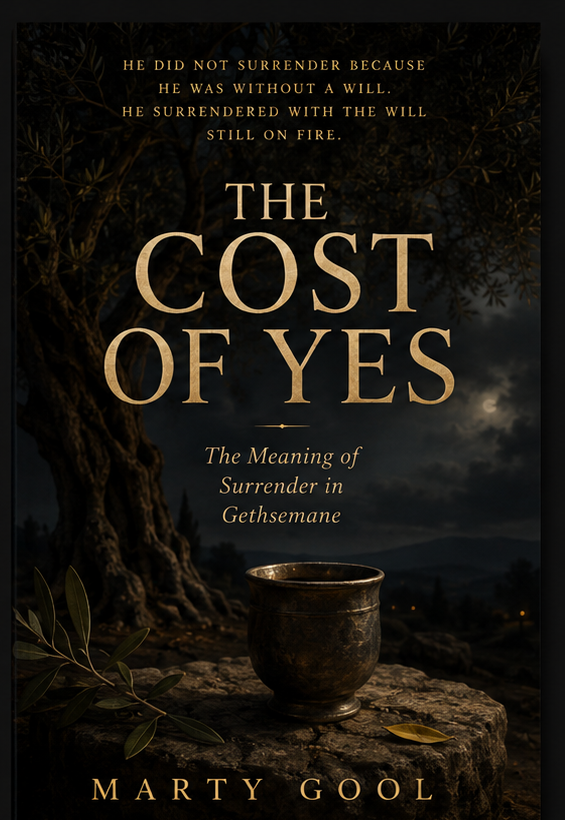
The Meaning of Surrender in Gethsemane
The Cost of Yes
The Meaning of Surrender in Gethsemane
by Marty Gool
This book asks you to stop in the corridor.
Instant download: Includes PDF + EPUB for all devices.
Read an Excerpt
We know it is there. We have read the verses. We understand in some general way that something heavy happened beneath those olive trees the night before the crucifixion. But we tend not to stay long. There is a cross to get to, and after that a resurrection, and the movement toward Sunday morning feels like the point. Gethsemane feels like a corridor — something you walk through rather than something you enter and sit inside.
This book asks you to stop in the corridor.
Not because darkness is where we are meant to remain, but because what happened in that garden is not a prelude to the gospel. It is the gospel made visible in a specific and demanding way. And if we skip past it too quickly — if we allow the pull of Easter morning to drain the weight from that Thursday night — we lose something that cannot be recovered anywhere else in the story.
What we lose is this: the sight of Jesus not wanting what was coming.
He fell to the ground. He sweat. He asked, if it were possible, that the cup be taken from Him. This is not a metaphor. This is not the literary device of a distant author constructing a scene for dramatic effect. This is the Son of God pressing His face toward the earth and saying, in plain language, that He did not want what the Father was asking Him to do. He wanted another way. He said so. He said it more than once.
And this is precisely where many of us grow uncomfortable.
We have constructed, quietly and over time, a picture of Jesus that does not easily accommodate what Gethsemane shows us. In this picture He is composed. He is beyond the reach of fear. He strides toward the cross with the settled calm of someone who feels nothing the ordinary human being would feel, because He is, after all, God. His divinity functions in this picture as a kind of insulation — keeping the worst of the human experience from fully landing on Him. He knows suffering is coming the way a surgeon knows a procedure will be painful. Clinically. From a distance.
This picture is clean. It is also, at its core, a way of managing our discomfort with what the Gospels actually record.
Because if we allow Jesus to have genuinely not wanted the cross — if we grant that the desire to be spared was real, present, and fully His — then we have to reckon with what His obedience actually cost. And that reckoning changes the nature of what He offers us. It means that when we bring Him our own dread, our own refusals, the places in our lives where we are being asked to do something we do not want to do, He is not receiving that pain from a position of immunity. He has held it. Not as an observer. As a participant.
The letter to the Hebrews does not treat this as a minor detail. It calls Jesus a high priest who was tempted in every way as we are, and it presents this as the ground of His ability to sympathize with our weakness. Sympathy built on knowledge alone — the sympathy of someone who understands suffering theoretically but has never been inside it — is a thin comfort. What Hebrews is pointing toward is something far more costly: a high priest who can hold our suffering because He has held His own.
Instant download: Includes PDF + EPUB for all devices.
Want more like this? I'll send new writing and book news — nothing else.
Readers of this book also read
