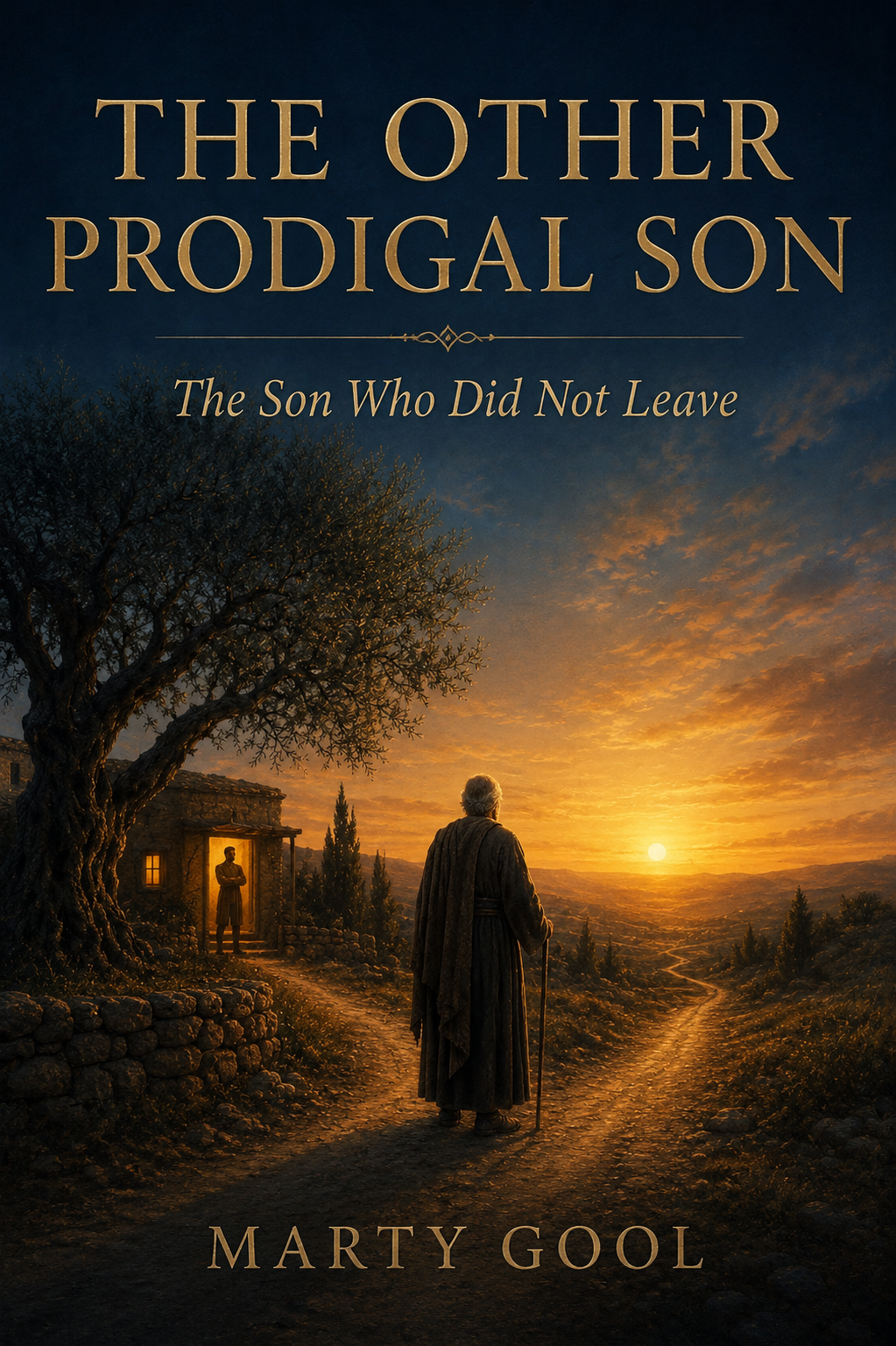
The Son Who Did Not Leave
The Other Prodigal Son
The Son Who Did Not Leave
by Marty Gool
Instant download: Includes PDF + EPUB for all devices.
Read an Excerpt
He was still a great way off when his father saw him. — Luke 15:20
The air does not punish the blood for being blue. It simply is what it is. And the blood — finally meeting it, turns red—because it cannot remain what it was.
He was there before the light was.
Every morning. Without fail. Without fanfare. Without an audience. The old man stood at the edge of his land and looked down the road.
Not because habit demanded it. Not because duty required it. Because love — when it is real — cannot stop watching the door.
Both directions. Always both.
East toward what was coming. West toward what had gone. He watched both. He honored both. He was not a man who protected himself from either possibility.
No one had to ask him why.
The answer was written in the way he stood.
Behind him — the land.
Not merely productive land. Living land. The kind that remembers who tended it and tends them back.
There was a tree on the north edge that had been there longer than anyone could account for. Longer than the Father. Longer than the Father's father. Its roots had broken through the lower wall twice and twice the wall had been rebuilt around them rather than the tree removed. Because some things earn the right to stay by simply outlasting every argument for cutting them down. Every morning the tree threw its shadow across the courtyard stones at the same angle. Faithful as sunrise. Faithful as mercy. The shadow moved through the day and returned the next morning to the same place it had always been.
The wall the tree had broken and been rebuilt around was low and broad. Fitted stone by stone by men who were not building to impress anyone but to endure everything. No two stones the same size. Each one chosen for how it fit against the one beside it. The kind of wall that takes longer to build because it requires attention. Because the builder has to stop and look and find the right stone rather than forcing the wrong one into place.
The Father had built much of it himself.
The air of the place carried bread from Miriam's kitchen — yeast and woodsmoke and the particular warmth of a fire that has been kept going through the night. Water in the cistern. Grain in the storehouse. The table never empty. The lamp never dark. No one on this land went without. Not because abundance was forced or performed. Because the Father knew — had always known — what enough looks like when it is real.
And every morning he turned his back on all of it and faced the road.
Not because he was ungrateful for what was behind him.
Because he knew what might still be coming toward him.
He had no name in this story.
Instant download: Includes PDF + EPUB for all devices.
Want more like this? I'll send new writing and book news — nothing else.
Readers of this book also read
