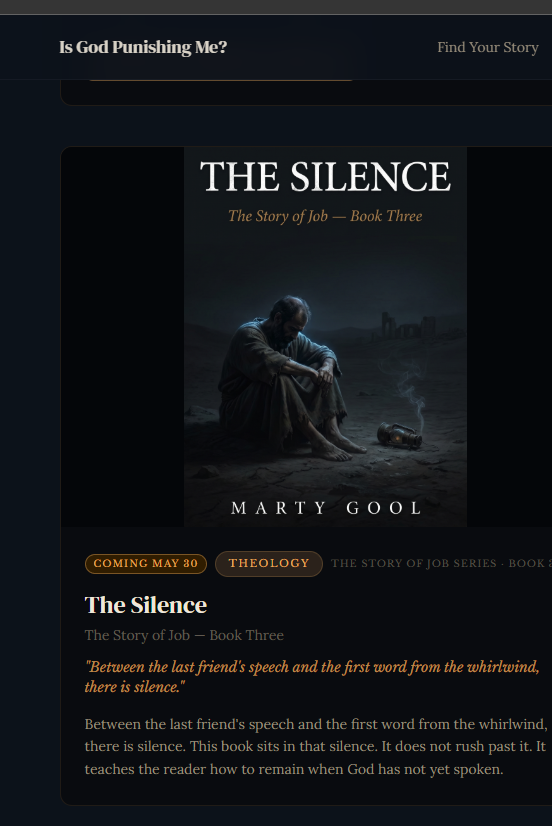
The Story of Job — Book Three
The Silence
The Story of Job — Book Three
by Marty Gool
Instant download: Includes PDF + EPUB for all devices.
Read an Excerpt
The men have nothing left to say.
Three of them are sitting in the ashes with their faces lowered. The fourth is sitting with a piece of broken pottery across his open palm. The wind moves across the ash heap and is not a voice. The light is late. The sky has the color the sky has at the end of a day in that country.
Zophar's mouth opened a little while ago and produced no sound.
Eliphaz turned his head, waited, turned his head back. Bildad has not lifted his head since he stopped speaking. The breath that was supposed to deliver the third verdict went out through Zophar's nose instead, and the nose did not announce itself, and the announcement was not made.
The friends have run out.
They have run out of the citations of the fathers. They have run out of the portraits of the wicked. They have run out of the rhetorical questions that were not asking. The arsenal that was full at the opening of the first cycle has emptied through three cycles, and the friends are sitting now with the empty quivers in their laps.
Job is watching the wind.
The shard is still across his palm. The skin is still open. The scraping has stopped. The body that produced the words underneath the scraping has gone still because the words have stopped, and the body is now waiting on something the body does not yet know to name.
The wind is not a voice.
The wind is a wind.
But Job's attention has gone there.
This is the book about the pause.
Not the pause between sentences. The pause between systems. The pause between what human wisdom can produce and what divine wisdom must give. The pause between the men who have spoken and the One who has not spoken. The room has been emptied of every other source of light, and the room is dim, and the room is waiting.
Three things a person reaches for when human wisdom runs out.
The first is poetry. When the propositions fail, the mouth reaches for the image. The miner. The mountain. The vein of silver. The image goes where the proposition cannot go, and the image admits, by the going, what the proposition would not admit.
The second is the oath. When the argument fails, the body reaches for the signature. The oath says what no argument has been able to say. The oath places the speaker's whole life on the bottom of the page, and the page is offered to heaven, and the page demands an answer.
The third is the lecture. When the room has gone quiet, a fourth voice rises, younger, full of words. The fourth voice does what the first three could not do. It speaks Job's name. It stands beside him. It claims to be the umpire he reached for. The fourth voice has read more carefully than the first three. The fourth voice is partially right. The fourth voice is also a voice, and a voice is what the room has had enough of, and the fourth voice is going to talk until the wind stops it.
Instant download: Includes PDF + EPUB for all devices.
Want more like this? I'll send new writing and book news — nothing else.
Readers of this book also read
